Research & Publications

Research Filter

Browse by publication date

The research page now keeps a single date-based filter for quicker browsing.

Publications

Publications

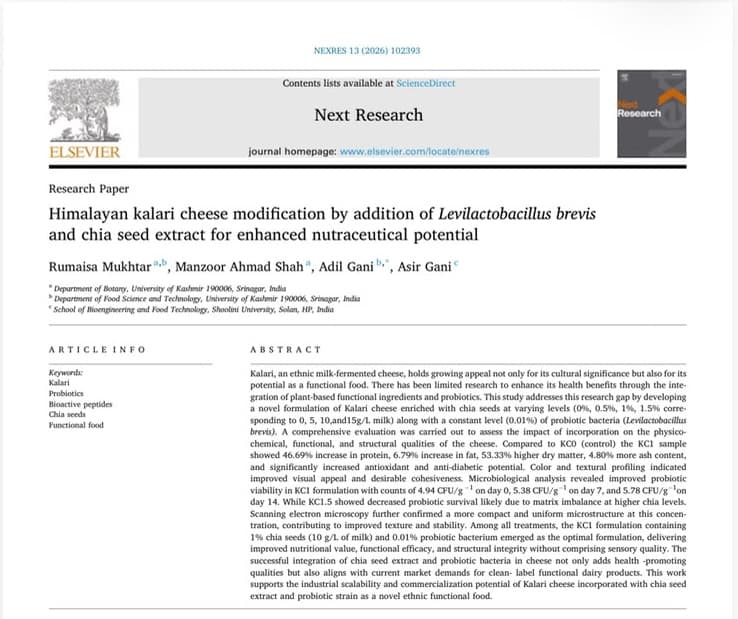
Himalayan kalari cheese modification by addition of Levilactobacillus brevis and chia seed extract for enhanced nutraceutical potential
publication

Himalayan kalari cheese modification by addition of Levilactobacillus brevis and chia seed extract for enhanced nutraceutical potential

Reference year: 2026

Kalari, an ethnic milk-fermented cheese, holds growing appeal not only for its cultural significance but also for its potential as a functional food. There has been limited research to enhance its health benefits through the integration of plant-based functional ingredients and probiotics. This study addresses this research gap by developing a novel formulation of Kalari cheese enriched with chia seeds at varying levels (0%, 0.5%, 1%, 1.5% corresponding to 0, 5, 10,and15g/L milk) along with a constant level (0.01%) of probiotic bacteria (Levilactobacillus brevis). A comprehensive evaluation was carried out to assess the impact of incorporation on the physico- chemical, functional, and structural qualities of the cheese. Compared to KC0 (control) the KC1 sample showed 46.69% increase in protein, 6.79% increase in fat, 53.33% higher dry matter, 4.80% more ash content, and significantly increased antioxidant and anti-diabetic potential. Color and textural profiling indicated improved visual appeal and desirable cohesiveness. Microbiological analysis revealed improved probiotic viability in KC1 formulation with counts of 4.94 CFU/g 1 on day 0, 5.38 CFU/g 1 on day 7, and 5.78 CFU/g 1 on day 14. While KC1.5 showed decreased probiotic survival likely due to matrix imbalance at higher chia levels. Scanning electron microscopy further confirmed a more compact and uniform microstructure at this concentration, contributing to improved texture and stability. Among all treatments, the KC1 formulation containing 1% chia seeds (10 g/L of milk) and 0.01% probiotic bacterium emerged as the optimal formulation, delivering improved nutritional value, functional efficacy, and structural integrity without comprising sensory quality. The successful integration of chia seed extract and probiotic bacteria in cheese not only adds health -promoting qualities but also aligns with current market demands for clean- label functional dairy products. This work supports the industrial scalability and commercialization potential of Kalari cheese incorporated with chia seed extract and probiotic strain as a novel ethnic functional food.

Authors

Rumaisa Mukhtar , Manzoor Ahmad Shah, Adil Gani, Asir Gani
publication

Resistant starch nanoparticle hydrogels using gum acacia as a delivery matrix

Reference year: 2024

Hydrogel development for targeted gut release and improved protection of sensitive functional compounds.

Authors

Dr Adil Gani Lab

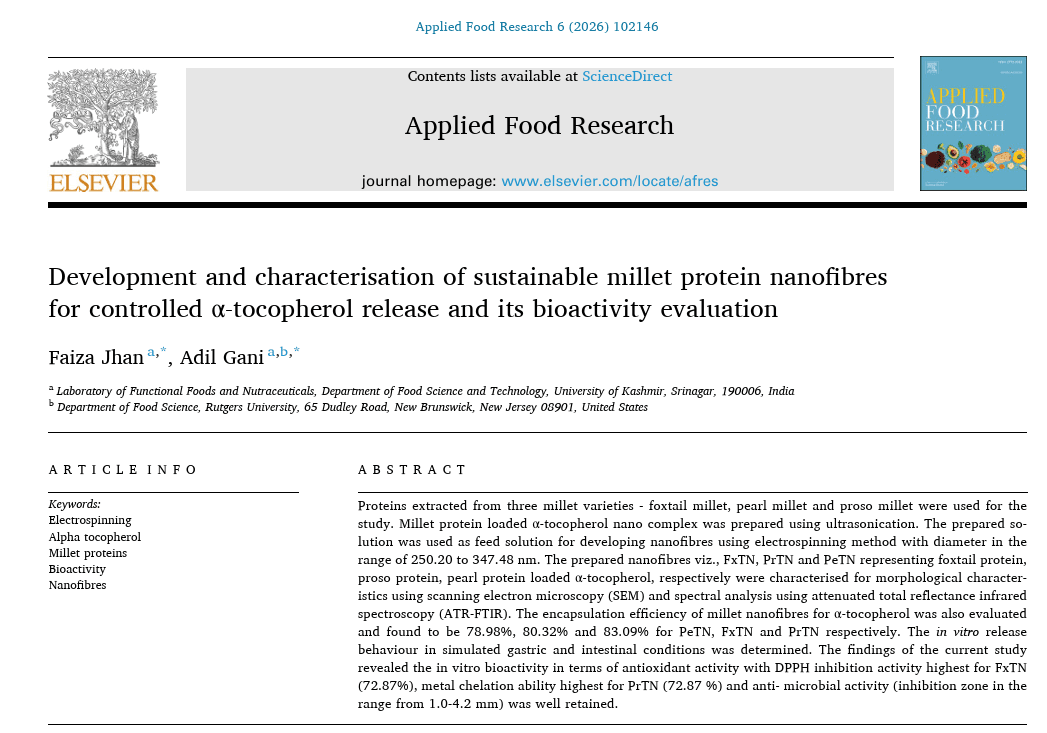
Development and characterisation of sustainable millet protein nanofibres for controlled -tocopherol release and its bioactivity evaluation
publication

Development and characterisation of sustainable millet protein nanofibres for controlled -tocopherol release and its bioactivity evaluation

Reference year: 2026

Abstract: Proteins extracted from three millet varieties - foxtail millet, pearl millet and proso millet were used for the study. Millet protein loaded α-tocopherol nano complex was prepared using ultrasonication. The prepared solution was used as feed solution for developing nanofibres using electrospinning method with diameter in the range of 250.20 to 347.48 nm. The prepared nanofibres viz., FxTN, PrTN and PeTN representing foxtail protein, proso protein, pearl protein loaded α-tocopherol, respectively were characterised for morphological characteristics using scanning electron microscopy (SEM) and spectral analysis using attenuated total reflectance infrared spectroscopy (ATR-FTIR). The encapsulation efficiency of millet nanofibres for α-tocopherol was also evaluated and found to be 78.98%, 80.32% and 83.09% for PeTN, FxTN and PrTN respectively. The in vitro release behaviour in simulated gastric and intestinal conditions was determined. The findings of the current study revealed the in vitro bioactivity in terms of antioxidant activity with DPPH inhibition activity highest for FxTN (72.87%), metal chelation ability highest for PrTN (72.87 %) and anti- microbial activity (inhibition zone in the range from 1.0-4.2 mm) was well retained.

Authors

Faiza Jhan , Adil Gani

publication

Whole-Grain Cereal Bioactive Compounds and Their Health Benefits: A Review

Reference year: 2012

Authors

Adil Gani, SM Wani, FA Masoodi, Gousia Hameed

publication

Emerging concepts in the nutraceutical and functional properties of pectin—A Review

Reference year: 2017

Pectin is a structural heteropolysaccharide found ubiquitously in terrestrial plants. It finds diverse food applications such as that of a gelling agent, stabilizer, and fat replacer.

Authors

Farah Naqash , F.A. Masoodi , Sajad Ahmad Rather , S.M. Wani, Adil Gani

Publisher

Elsevier

Books

Books

book

Functional Biopolymers and Nutraceutical Delivery

Reference year: 2023

Book Record

Rich bibliographic metadata enabled

Functional Biopolymers and Nutraceutical Delivery

Authors

Dr Adil Gani, Research Team

Publisher

Academic Research Press

Edition

2nd Edition

Publication Date

Aug 14, 2023

ISBN-10

9381234567

ISBN-13

9789381234567